
Peptide integrity is not a fixed property of a vial — it is a time-dependent outcome of chemistry, handling, and storage discipline. For research organizations relying on consistent, reproducible results, understanding how and why peptides degrade is as important as understanding the assay itself.
Peptides are chemically fragile relative to small-molecule compounds. Their amide backbones and reactive side chains make them susceptible to several well-characterized degradation pathways, and the rate at which these pathways proceed is governed almost entirely by storage conditions. This guide summarizes the underlying chemistry and translates it into practical storage guidance for a laboratory setting.
Why Peptides Degrade: The Core Chemical Pathways
Research indicates that most peptide quality loss can be attributed to a small number of degradation mechanisms, each with a distinct chemical driver and analytical signature.
Hydrolysis
Hydrolysis is the cleavage of the peptide backbone by water. Even lyophilized (freeze-dried) material retains trace residual moisture, and this — along with humidity absorbed after the vial is opened — can slowly cleave susceptible bonds over months to years. Aspartate-proline bonds are considered the most acid-labile linkage in a peptide sequence; asparagine-glycine bonds are similarly vulnerable via succinimide intermediates. On reversed-phase HPLC, hydrolytic degradation typically appears as new, smaller fragment peaks eluting earlier than the parent peak.
Oxidation
Oxidation is widely regarded as the most frequently observed degradation pathway in stored peptides. It involves addition of oxygen to reactive side chains and is accelerated by atmospheric oxygen, ambient light, and trace metal ions. Methionine, cysteine, tryptophan, tyrosine, and histidine residues are the most oxidation-prone, meaning sequences containing them generally require more conservative storage (inert atmosphere, opaque containers).
Deamidation and Aggregation
Deamidation converts asparagine and glutamine residues into aspartate or glutamate derivatives, subtly altering charge and retention time. Aggregation, by contrast, is a physical change: hydrophobic peptides can self-associate into oligomers or visible precipitates without any change in molecular mass. It does not always produce a new mass spec peak, but it reduces recoverable material and can distort assay readouts — a peptide that "disappears" from solution is not necessarily chemically degraded, it may simply be out of solution.
Lyophilized vs. Reconstituted Stability
Lyophilization dramatically slows the pathways above by removing the water needed to drive hydrolysis and limiting molecular mobility within the freeze-dried cake. Published stability literature consistently shows that lyophilized peptides, stored appropriately, remain stable far longer than the same peptide once dissolved in an aqueous buffer. Higher storage temperatures speed up chemical degradation, which is why storage conditions matter as much as the assay itself.
Reconstituted peptides are far more reactive because the backbone and side chains are fully solvated and mobile. Once in solution, hydrolysis and oxidation rates increase substantially, and the solution becomes vulnerable to microbial contamination without sterile technique. Handling of reconstituted material should follow the laboratory's own validated protocol.
Freeze-Thaw Cycling
Repeated freeze-thaw cycles introduce stress beyond simple time-at-temperature. Ice crystal formation can create localized changes in solute concentration and pH ("freeze concentration"), and repeated thermal cycling promotes aggregation in susceptible sequences.
Where to find storage conditions for your product
Store each product exactly as its product page and vial label state. Those published conditions are the storage source for every Ageless Peptides product.
| Where | What it shows |
|---|---|
| Product page | The storage conditions for that product |
| Vial label | The storage conditions printed for that product |
| Safety Data Sheet | Section 7, Handling and Storage |
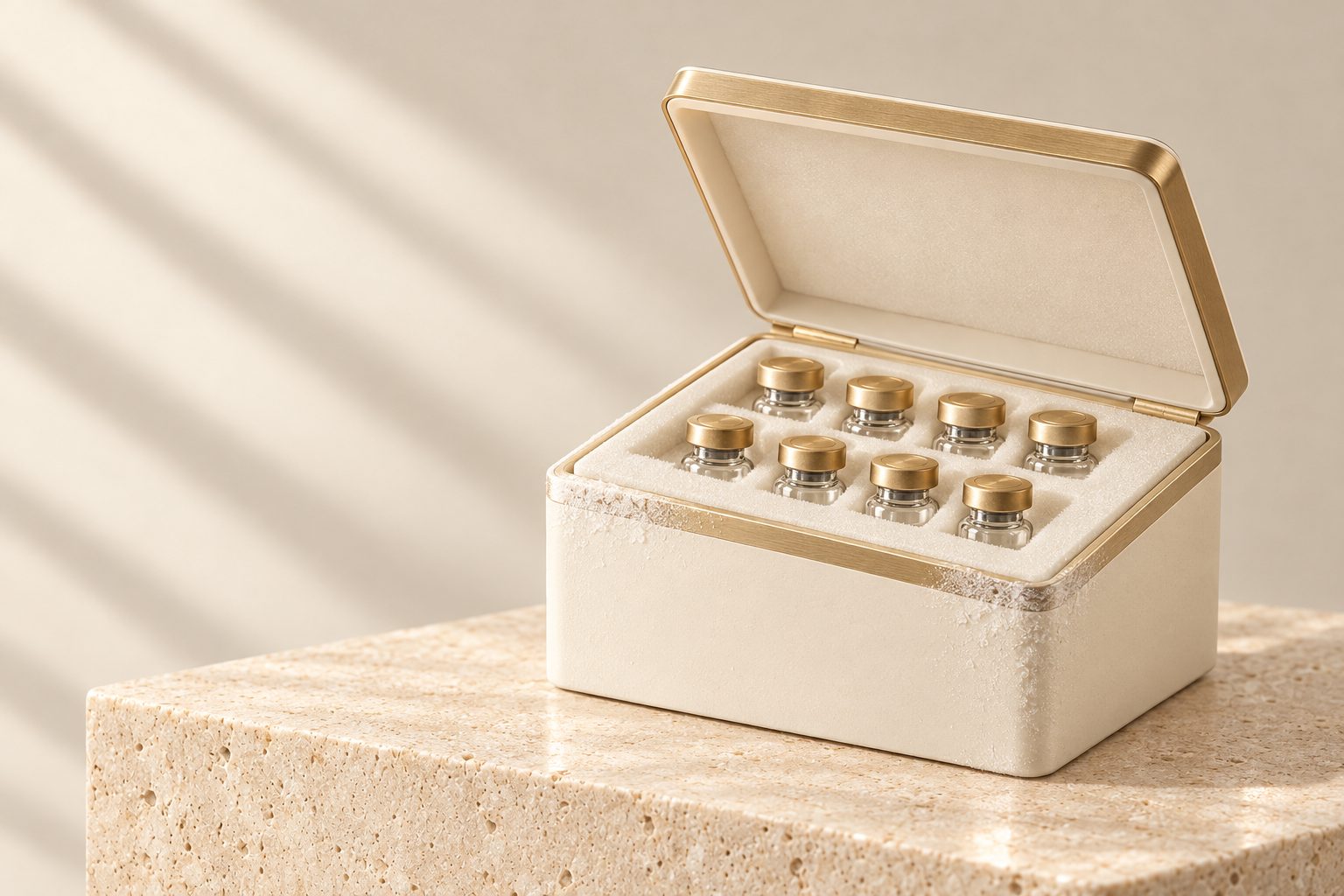
For sealed lyophilized vials, the product pages list: store the sealed vial at -20°C, protected from light and moisture, and allow the vial to reach room temperature before opening to limit condensation. Products supplied in other forms list their own conditions on their product page.
If the product page, vial label and Safety Data Sheet do not match, contact Ageless Peptides support before storing or using the vial.
Sequence also matters: peptides with Met, Cys, Trp, Tyr, or His warrant caution around oxygen and light, and peptides with Asp-Pro or Asn-Gly motifs warrant caution around moisture.
Verifying Stability Analytically
Because degradation is not always visually apparent, researchers confirming stability over time typically use the same tools as initial quality testing: reversed-phase HPLC to detect new degradation peaks and monitor purity trends, and mass spectrometry to confirm the observed mass still matches the expected sequence. Periodic re-testing of long-held stock is a reasonable practice for extended studies.
Conclusion
Peptide stability follows well-documented chemistry: hydrolysis, oxidation, deamidation, and aggregation each proceed faster under heat, light, moisture, and freeze-thaw stress. Following the listed storage conditions for each product, and checking each lot's COA, keeps results consistent across experiments.
Frequently Asked Questions
What is a lyophilized vial?
A vial of freeze-dried (lyophilized) powder. Removing the water slows the chemical reactions that degrade peptides.
How are sealed lyophilized peptide vials stored?
The product pages list -20°C, protected from light and moisture, with the vial allowed to reach room temperature before opening. Always follow the product page, vial label and Safety Data Sheet for the product you hold.
References
- Manning MC, et al. Stability of protein pharmaceuticals: an update. Pharm Res. 2010;27(4):544–575.
- ICH. Q1A(R2) Stability Testing of New Drug Substances and Products. 2003.
Related Reading
- Peptide Stability Testing Protocol
- Batch Consistency in Peptide Quality
- COA Meaning: How to Read a Peptide Certificate of Analysis
All products sold by Ageless Peptides are for Research Use Only. Not for human or animal consumption.