
Tesamorelin and sermorelin are both GHRH analogues. Sermorelin is the 29-residue N-terminal fragment GRF(1-29)-NH2; tesamorelin is the full 44-residue hGRF(1-44)-NH2 with a trans-3-hexenoyl group on the N-terminus.
| Property | Tesamorelin | Sermorelin |
|---|---|---|
| Class | Synthetic 44-amino-acid GHRH (GRF) analogue with an N-terminal trans-3-hexenoyl group [1] | 29-amino-acid N-terminal fragment of human growth hormone-releasing hormone, GRF(1-29)-NH2 [2] |
| Molecular formula | C221H366N72O67S [1] | C149H246N44O42S [2] |
| Molecular weight (g/mol) | 5136 [1] | 3357.9 [2] |
| CAS number | 218949-48-5 [1] | 86168-78-7 [2] |
| PubChem CID | 16137828 | 16132413 |
| Sequence | trans-3-hexenoyl-hGRF(1-44)NH2 [1] | YADAIFTNSYRKVLGQLSARKLLQDIMSR-NH2 [2] |
| Regulatory status | Research material; not an FDA-approved drug product | Research material; not an FDA-approved drug product |
| WADA 2026 | Named under S2.2.4 (GHRH analogues), prohibited at all times [3] | Named under S2.2.4 (GHRH analogues), prohibited at all times [3] |
| Supplied by Ageless Peptides | Yes | Yes |
Tesamorelin
Tesamorelin: synthetic 44-amino-acid GHRH (GRF) analogue with an N-terminal trans-3-hexenoyl group. [1] FDA: research material, not an FDA-approved drug product; not for human or veterinary use. WADA 2026: named under S2.2.4 (GHRH analogues), prohibited at all times. [3]
Full reference: Tesamorelin research reference
Sermorelin
Sermorelin: 29-amino-acid N-terminal fragment of human growth hormone-releasing hormone, GRF(1-29)-NH2. [2] FDA: research material, not an FDA-approved drug product; not for human or veterinary use. WADA 2026: named under S2.2.4 (GHRH analogues), prohibited at all times. [3]
Full reference: Sermorelin research reference
Storage and handling
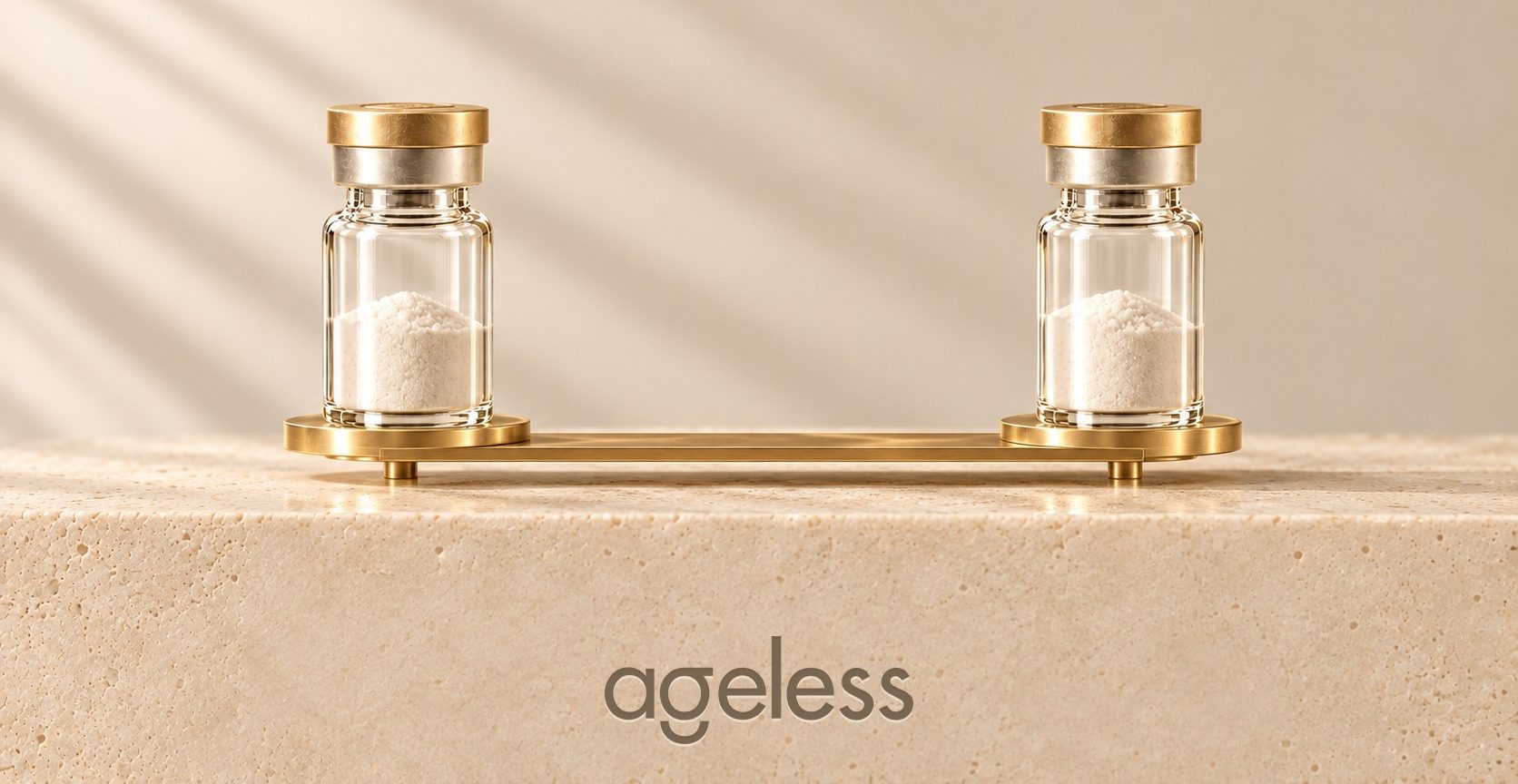
Both are supplied as lyophilized solids in sealed vials. Store sealed vials at -20°C, protected from light and moisture, and allow a cold vial to reach room temperature before opening. Product-specific conditions are listed on each product page and Safety Data Sheet.
Lot documentation
Each lot of each product has its own Certificate of Analysis. Each vial label carries a serial number linked to its lot: scan the code on the label and enter the serial number to see the COA for that vial's lot. Compare products only against the COA for the exact lot used.
Research use only
Ageless Peptides supplies these compounds as lyophilized material for laboratory research only. They are not drugs, foods, cosmetics or dietary supplements, are not for human or veterinary use, and nothing on this page is medical advice or a statement of safety or effectiveness for any human or veterinary use.